Description
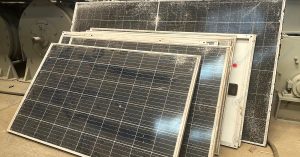
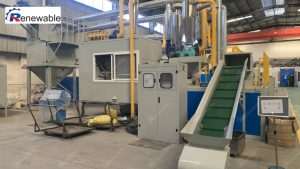
The large-scale solar photovoltaic panel recycling plant produced and developed by Henan Renewable Energy Technology Co., Ltd. is environmentally friendly,non-toxic,has high separation efficiency,low cost and is easy to process.It has important application value and academic value.Photovoltaic panel processing equipment extracts glass,aluminum,silicon powder,copper powder and EVA plastic powder with high market value through physical technology and cracking process.
Solar Panel The Value Of Recycling
Most of the waste photovoltaic panel components can be recycled, including 65%-75% glass, 5%-10% aluminum frame, 10% plastic (encapsulation machine and backplane), 3%-5% silicon, 1% copper And less than 0.1% of silver, tin, lead, etc., has a very high recovery value, the recovery rate can reach more than 95%. Macquarie University in Australia calculates that the economic value of materials contained in 800,000 tons of photovoltaic waste is around US$1.25 billion. Since the photovoltaic panels contain more than 70% of high-transparency glass, they can be processed into channel glass, which can be used as photovoltaic wall building materials or laid on sidewalks to continue generating electricity; silicon cells can be recycled into powder and used as heat dissipation materials. The precious metal silver contained in it can also be reused; the PVDF polyvinylidene fluoride in the back sheet can also be made into Teflon, so as to maximize the recycling value. Recycling photovoltaic panels has low cost and zero pollution, and recycled materials can also be made into new photovoltaic panels.
Solar Panel physical recycling technology
Scrap photovoltaic panels first pass through a deframing machine, removing the aluminum frame and junction box, leaving the panels without the frame and junction box. The panels, stripped of the aluminum frame and glass, are then crushed and sorted to separate metals from non-metals, extracting valuable silicon powder, copper powder, and plastics. The recovery rate can reach over 98% (depending on the actual material).
Solar Panel physical recycling process
Waste photovoltaic panels can be recycled into aluminum frames, glass, silicon powder, copper powder, and EVA plastic through the physical recycling process.
There are generally three main steps for the recyclingof photovoltaic modules
First step is to disassemble the junction box and remove aluminum frames by machine;
Second step is to remove the tempered glass;
Third step The panels are crushed and sorted the silicon powder and copper powder and plastic powder.
The photovoltaic panel processing equipment sort silicon powder, copper powder and plastic powder with high market value through physical crushing and sorting.
1. Remove the junction box and aluminum frames
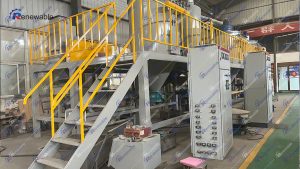
This equipment is specially used in the field of solar photovoltaic panel disassembly, in particular relates to a frame and junction box removal equipment for the aluminum frame and junction box of solar photovoltaic panel.
2. Remove the glass
This equipment is specially designed for glass removal equipment of photovoltaic modules, which can efficiently, quickly and safely remove glass from photovoltaic modules, with a glass removal rate of more than 98%.
3.Panel crushing and sorting
Firstly, the scrapped photovoltaic panels enter the shredder to be shredded in small pieces. Second, The shredded materials will be crushed by the crusher .Third, the crushed materials enter the vibrating sieving machine and Sieve out a small part of the silicon powder. Fourth, The material enters the grinding system and separates all copper powder and plastic powder through the air separator. At the same time, the last remaining silicon powder is sieved through a circular vibrating screen. During the whole processing, the dust will be collected by the dust removal system.
Solar panel pyrolysis recycling technology
In the processing of waste photovoltaic panels, the frames and junction boxes are first removed. The preprocessed panels are then fed into a cracking furnace for high-temperature pyrolysis, yielding a mixture of glass chunks, silicon wafers, and copper wires (referred to as photovoltaic bulk materials). Subsequently, the pyrolyzed mixture is conveyed to a feed bin. It then undergoes sequential separation through two layers of vibrating screens and multiple air flow classifiers, supplemented by a wind separator and an eddy current separator. Concurrently, dust is treated using dust collectors (including pulse dust collectors). Ultimately, glass, silicon wafers, and copper wires are sorted and recovered.
Solar panel pyrolysis recycling process
The pyrolysis recycling process for photovoltaic modules generally consists of three main steps:
Step 1: Waste solar photovoltaic panels are transported into the reactor by a claw-type machine. This process usually takes about 2 hours. Once the reactor is full, the door is closed and heating begins.
Step 2: The pyrolysis furnace is heated by resistance heaters. When the temperature rises to the set value, the cracking process starts, which takes about 8-10 hours.
Step 3: The products after pyrolysis are sorted to obtain silicon wafers, copper wires and glass.
Comparison of solar panel logistics and pyrolysis processes
Advantages
1. Adopt international advanced crushing and sorting technology to realize the reuse of solar panels.
2. The operation method is simple, the separation process is environmentally friendly and non-toxic, the separation efficiency is high and the cost is low, and it is easy to handle on a large scale;
3. Compact structure, reasonable layout, stable performance and low noise.
4. Long service life, low failure rate and low maintenance cost.
5. The efficiency of pulse dust removal equipment is as high as 99%, effectively suppressing dust volatilization, fully complying with the national environmental protection requirements “Comprehensive Emission Standard of Air Pollutants” GB16297-1996, without secondary pollution.
6. The waste photovoltaic panel recycling equipment adopts PLC to control the complete production line; uniform feeding and coordinated operation.