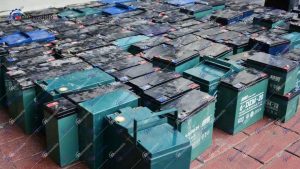
As more and more countries attach importance to environmental protection, new energy vehicles are being developed and promoted in more and more countries. The service life of the power lithium-ion battery is about 20 years, but the relevant car can only be cancelled within three to five years, because its initial capacity of capacity decay is lower than 85%, the range of electric vehicles will be significantly reduced, and the power lithium-ion battery will be significantly reduced. Ion batteries must be replaced every 3 to 6 years, so the high price also limits an important factor in the promotion of electric vehicles.
After entering the waste lithium iron phosphate battery into the feeding system, it is depleted in oxygen and broken (depleted oxygen means that it does not react with active substances to avoid dangers such as explosion), and after a series of reactions. The separator, positive and negative electrode powder, copper and aluminum and other metals are separated and recovered, and the obtained separator, positive and negative electrode powder and metal purity are very high, and can be directly recycled and reused. With physical and chemical processing methods, the reaction is carried out in a confined space to avoid the occurrence of copper and aluminum oxidation problems, so as to achieve the real recycling of positive and negative plates of lithium batteries, and achieve 99% separation efficiency of copper aluminum, diaphragm and shell.
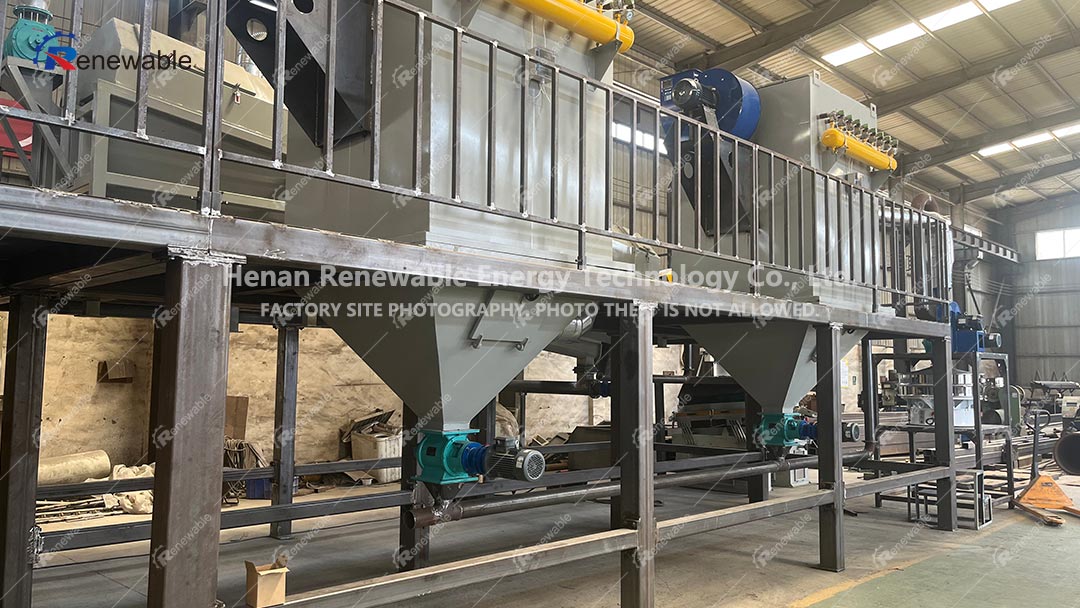
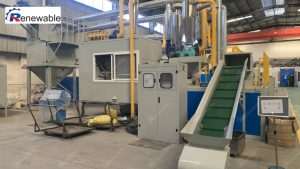
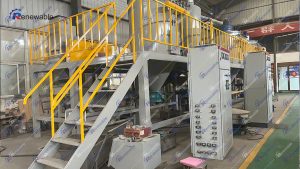
Lithium Battery Recycling Plant Workflow
1.Fully discharged, the discharged waste lithium battery crushes the material to about 10cm by crushing, and then enters the carbonization furnace through the conveyor, the separator is directly carbonized during the carbonization process, the electrolyte can be pyrolyzed and gasified, and the adhesive is gasified. Because the furnace is almost a confined space, the anaerobic conditions are met, so that the diaphragm, adhesive and electrolyte are heated inside the carbonization furnace for pyrolysis and gasification, and the flue gas generated passes through the recovery pipeline and flue gas purification system to achieve the effect of reciprocating circulation heating and hydrolysis.
2.The carbonized material is then screened through the crusher through the wind conveying system into the fully enclosed linear screen for the first screening, and the positive and negative electrode powder is driven to the closed conveyor below through the linear sieve and transported to the ton bag (a finished powder).
3. The remaining diaphragm, copper and aluminum, shell, etc. pass through the belt magnetic separator to separate the iron in the material, and the diaphragm enters the ton bag for collection through the wind extraction equipment.
4. After removing iron, the material enters the grinding machine for grinding, and the ground material particles are about 50-60 mesh, which enters the cyclone aggregate through negative pressure conveying, and then enters the drum screening machine through the discharge. The upper layer of the drum screen is discharged into large particles such as diaphragm and plastic, which can be directly bagged, and the middle layer of materials is conveyed into the specific gravity separator for copper and aluminum separation.
5.The lower material is finished black powder, which can be directly bagged. In addition, the air outlets from the crusher, linear screen, aggregate, copper and aluminum separator are connected with the dust collector for dust removal and odor removal. In this way, the entire set of equipment completes the process required for production. The advantages of this set of equipment are simple structure, less loss parts, high efficiency, high powder yield, low copper and aluminum content of finished materials, and less spilled dust.
The technical route of recycling batteries is quite complicated. For example, in the treatment of waste lithium-ion batteries, they must first be pretreated, including discharge, disassembly, crushing, and sorting; plastic and iron shells can be recycled after disassembly; and then use physical methods. The electrode material is extracted, and then extracted by various processes.
With the overall increase in demand for electric vehicles, lithium-ion batteries will also be in short supply. Therefore, many countries have called for preliminary research on the recycling of power lithium-ion batteries and the establishment of special recycling institutions. As more and more countries attach importance to environmental protection, new energy vehicles are being developed and promoted in more and more countries.