Project Description
Dry-type cable recycling machines, also known as waste wire and cable recycling equipment or integrated cable recycling equipment, have advantages such as reasonable structure, simple operation, stable operation, intelligent control, and high output, making them the preferred equipment for waste wire and cable recycling. Multiple machines can work together to complete the operation with a single feeding. Equipped with a separation device, it has strong processing capacity and good material separation effect. It not only solves the drawbacks of copper extraction by incineration but also improves the recycling rate of copper and plastics. Waste wire and cable recycling and sorting equipment not only overcomes the problems of resource waste and secondary pollution in traditional mechanical wire recycling but also effectively improves the recycling rate of metals in waste wires and cables.
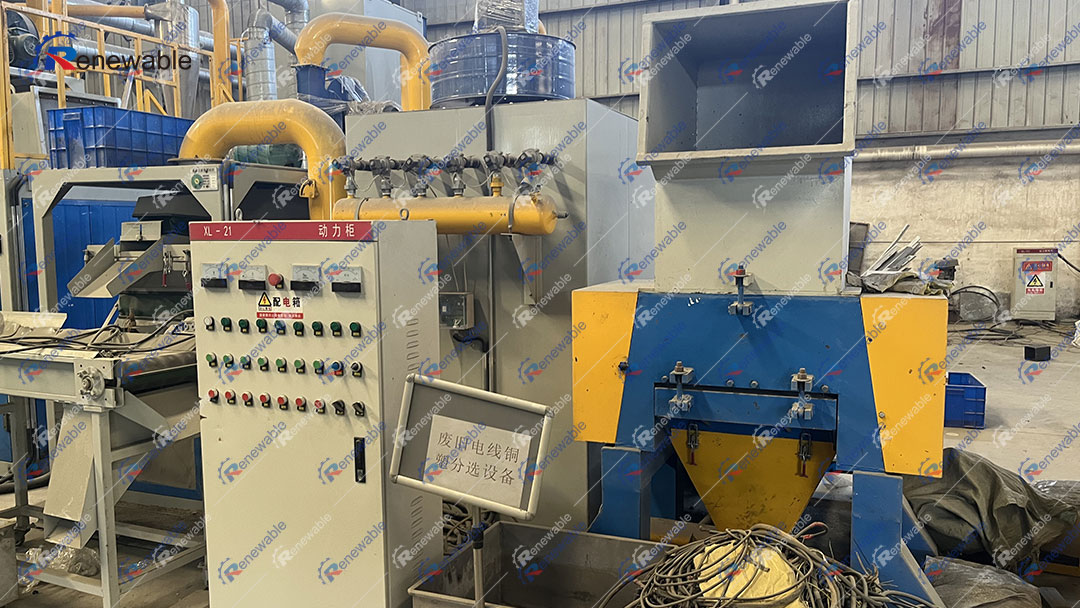
Waste Wire and Cable Recycling Equipment
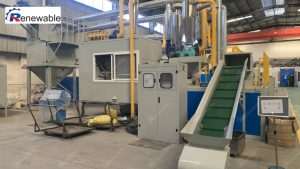
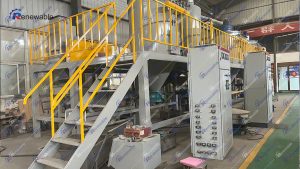
The dry-type cable recycling machine has the following structure: a feeding conveyor belt is installed at the bottom of the crusher, with the bottom discharge port corresponding to the bottom of the feeding conveyor belt; a magnetic separator is installed in the middle of the feeding conveyor belt, connected to the iron powder discharge port; a separation bed is installed above the conveyor belt; a frequency converter is installed on one side of the separation bed; a cable recycling discharge port is located at the top front; a plastic discharge port is located at the rear; a front speed regulator is located on one side of the top; rear speed regulators are located on both sides; and a dust suction port is located at the top. A transparent soft cover is installed around the dust suction port to cover the top of the separation bed. One end of the dust suction port is connected to a dust suction pipe, and the other end is connected to a blower. One end of the top of the crusher is connected to a dust suction hose, and the other end is connected to the middle of the dust suction pipe. The upper end of the blower is connected to a dust collection pipe, the lower end is connected to the upper end of the exhaust pipe, and the lower end is connected to a dust collection box. The advantages of this utility model patent technology are: good processing effect on waste cables, able to remove iron powder that may be contained within them; adjustable blower speed, energy saving and power saving, and uniform speed. It effectively absorbs dust generated during the separation process, protecting the environment.
On the production line, waste wires undergo mechanical crushing, belt conveying, magnetic separation, gravity separation, and electrostatic separation using a dry-type cable recycling machine. This effectively removes fibers and dust generated during production, achieving centralized and efficient processing and thus effectively eliminating environmental pollution. This equipment is suitable for processing various household wires, cables, communication cables, and optical fibers. It ensures the separation, crushing, and recycling of the insulation and conductive core layers of waste wires and cables.