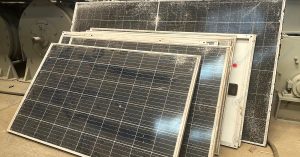
The invention of aluminum-plastic composites has brought numerous conveniences to our daily lives. As a more practical material, aluminum-plastic products such as aluminum-plastic panels and medical panels are widely used in building materials and daily necessities. These products retain their properties largely after use, thus possessing good recycling value. However, since they are a mixture of two materials, their recycling value is significantly reduced without separation.
Recognizing the recycling value of aluminum and plastic, people have been striving to find methods to separate them.
Initially, although we knew the recycling value of aluminum and plastic, we couldn’t find a way to separate them, leaving us with only landfill or incineration options. This not only caused environmental problems but also wasted resources and value. Later, some people began trying chemical methods for recycling, but these were costly, caused environmental pollution, and sometimes even affected resource quality.
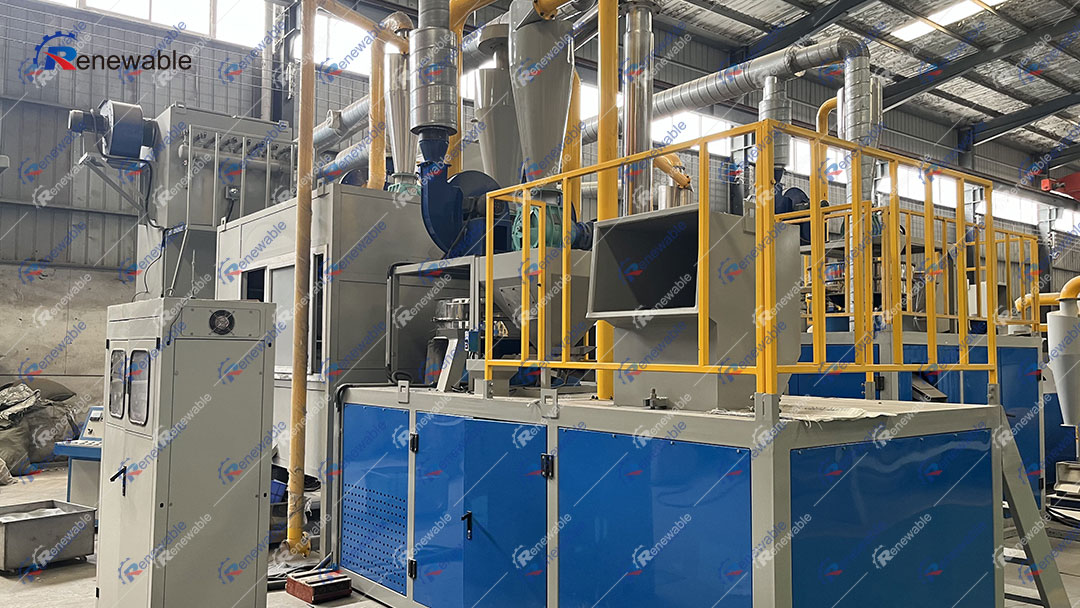
In fact, aluminum-plastic separation doesn’t require high costs or complicated procedures. Aluminum-plastic electrostatic separators use a purely dry physical separation method, offering fast separation speed, high efficiency, and eliminating environmental and quality issues.
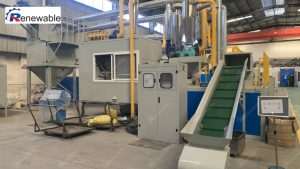
Henan Renewable Energy Technology Co., Ltd. has developed an aluminum-plastic separation and recycling equipment for recycling aluminum and plastic from municipal solid waste. The process includes crushing, electrostatic separation, and the separation of metals and non-metals. First, a large quantity of material is fed into a crusher for secondary crushing and tertiary grinding. Then, a rotary screen separates materials that meet the particle size requirements. Finally, a double-roller electrostatic separator separates the plastics and aluminum. The entire process is a physical separation, requiring no heating, burning water, or chemical reagents, making it very environmentally friendly and pollution-free. This process is low-cost, highly efficient, and achieves a separation rate of up to 99.8%. Furthermore, the equipment is a fully automated production line, saving manpower; only one or two people are needed to operate it. This production line has wide applications, is easy to install, and can be assembled in various ways to adapt to different locations.
The aluminum-plastic electrostatic separator is named as such because it is commonly used for separating aluminum and plastics. While it can separate most mixed metal and non-metal materials, such as copper and plastic, it cannot completely separate metals from metals or plastics from plastics. Metal sorting machines can separate metals such as stainless steel from solid waste, while electrostatic plastic sorting machines are used to differentiate plastics based on their material composition. Furthermore, environmentally friendly aluminum-plastic separators, separation equipment, and separators can separate various conductive and non-conductive substances, as well as metals and non-metals. They are primarily used for waste printed circuit boards (copper and PCBs), various pharmaceutical boards, aluminum-plastic composite panels, food packaging bags, milk bags, toothpaste tubes, Wahaha bottle caps, aluminum-plastic pipes, aluminum foil paper, and metal ore beneficiation, with significant separation effects. Since the city processes a large amount of waste annually, using aluminum-plastic separation equipment can turn this waste into valuable resources without causing secondary pollution. The environmentally friendly and energy-saving production separation methods result in a significant return on investment.