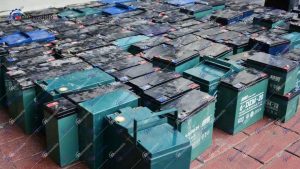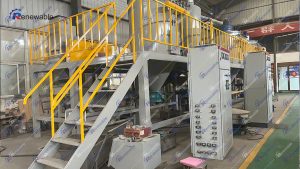
With rapid economic development, the recycling of scrap copper is becoming increasingly important, and countries are striving to increase the proportion of scrap copper in their raw materials. How to utilize scrap copper and employ a reverberatory furnace refining process to produce low-oxygen bright copper rods from scrap copper through continuous casting and rolling is a crucial research topic for technical personnel.
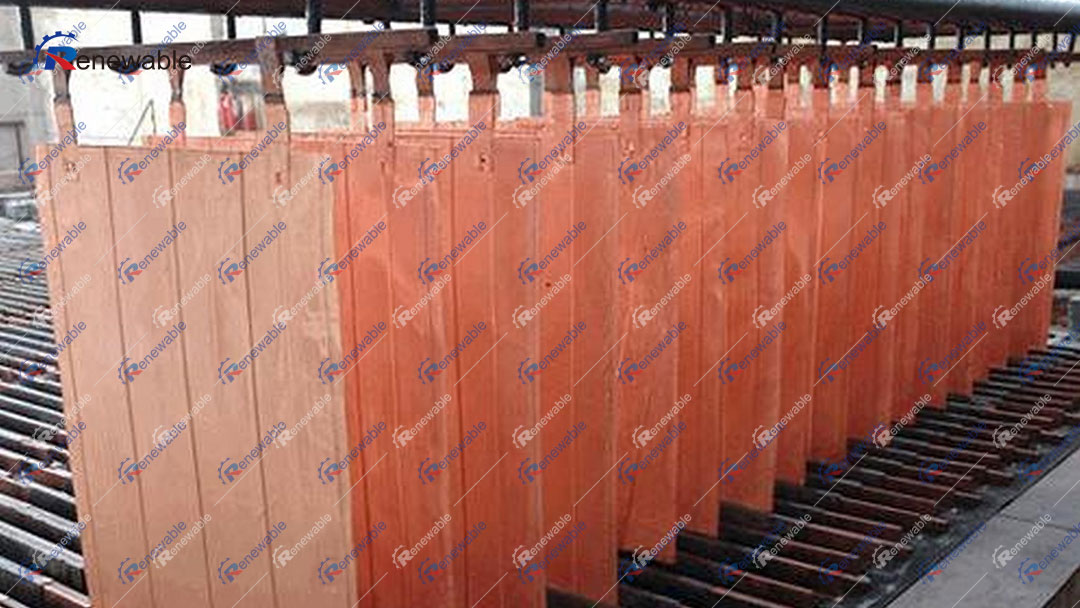
Our company primarily achieves scrap copper refining through the following technology. The production process at our recycling plant is as follows: Scrap Copper → Reverberatory Furnace Smelting → Oxygen Blowing → Refining → Reduction → Holding Furnace Refining → Casting → Rolling and Trimming → Rough Rolling → Finish Rolling → Cooling → Cable Finishing → Discharge.
Copper Electrolytic Refining Process
Production Process Description
1. Scrap Copper:
Scrap copper smelting can produce three grades of copper rod raw materials. Grade 1 scrap copper requires clean, untinned, uncoated, and unalloyed copper wire and cable. Do not use charred copper wire; charred copper wire is unalloyed copper wire with a nominal content of 96%. Grade II scrap copper consists of small-diameter, uninsulated copper wire, copper tubes, varnished or insulated copper busbars, and clean copper rods, with a minimum content of 94%. Grade III scrap copper is a mixture of unalloyed scrap copper, with a standard copper content of 92%. To obtain the optimal material combination and achieve the best results, the general material ratio added to the furnace is: Grade I scrap copper: 30%; Grade II scrap copper: 60%; Grade III scrap copper: 10%.
2. Reverberatory Furnace Smelting:
The key to producing copper rods from scrap copper smelting lies in controlling the composition of the molten copper. The core equipment is the refining furnace. The refining furnace is made of refractory material, and the furnace body can be tilted to facilitate degassing, slag removal, and casting. The key to the entire production line lies in its process flow: raw materials → feeding → smelting → oxidation → reduction → casting. First, the raw materials should be prepared according to the source grade of the scrap copper, and then reactants should be added according to the raw material ratio. Scrap copper undergoes primary refining in a refining furnace, rapidly melting the copper. A slag-removing agent is then added to achieve optimal homogeneity in the molten copper. Oxygen-enriched air is then introduced to float oxide impurities to the surface of the molten pool for cleaning. The main impurities in refined copper are lead, tin, zinc, iron, arsenic, antimony, and sulfur. These elements significantly affect the processing technology and conductivity of copper rods. Therefore, secondary refining is usually required to further remove impurities. The final reduction process involves introducing reducing gas into the furnace to adjust the oxygen content of the copper to the required range of 200-350 ppm.
3. Holding Furnace Refining:
Holding furnace refining maintains the copper molten metal at a high temperature. Non-copper inclusions, due to their different specific gravity from the copper molten metal, will float or sink, further purifying the copper molten metal and ensuring that the chemical composition of the copper wire rod meets the standard requirements.
4. Casting:
Casting is performed using a five-wheel steel strip continuous casting machine. The five-wheel steel strip continuous casting machine consists of a casting wheel, two pressure rollers, a tensioning roller, an idler roller, and a steel strip. The grooves and clamping devices on the steel strip form the pouring cavity for the molten copper. Both the casting wheel and the steel strip are equipped with cooling systems, purging systems, carbon injection systems, and ladle preheating devices.
5. Edge Rolling:
The pretreatment of the steel billet includes clamping, shearing, and edge rolling. The steel billet output from the continuous casting machine is fed to the cutting head of the shearing machine via clamping rolls, or defective products are cut off, and then the edges are removed by milling.
6. Roughing and Finishing Rolling:
The copper bar tandem mill is a twin-roll cantilever mill, divided into
into two sets of rough rolling and finishing rolling. The rolls of rough rolling and finish rolling are arranged alternately, horizontally and vertically. The rough rolling mill adopts a large amount of reduction under a large pressure to refine the grain. Finish rolling to ensure the dimensional accuracy and surface finish of the copper rod.
7 cooling:
The copper rod exiting the continuous rolling mill enters a cooling pipe about 20 meters long and slopes upwards. In the cooling pipe, the copper rod is cooled by a slightly acidic alcohol solution, cleaned and descaled to avoid re-oxidation.
8. Cable arrangement and output:
After cooling and cleaning, the copper rod is changed from the horizontal position of the rolling line to the vertical position of the winding machine by the curved roller table, and then enters the post-processing device of the copper rod and the winding machine. The copper rod is wound into a spiral shape in the rod winding machine according to the user’s requirements and packed into the warehouse.